
What is an OnChain Passport
An OnChain Passport is a self-sovereign identity tool that moves reputation data from centralized silos to the blockchain. It establishes a verifiable, tamper-proof record of a user’s digital history, allowing applications to assess trust without exposing raw personal data. This shift is foundational for DeFi compliance, enabling protocols to distinguish real users from bots while maintaining privacy.
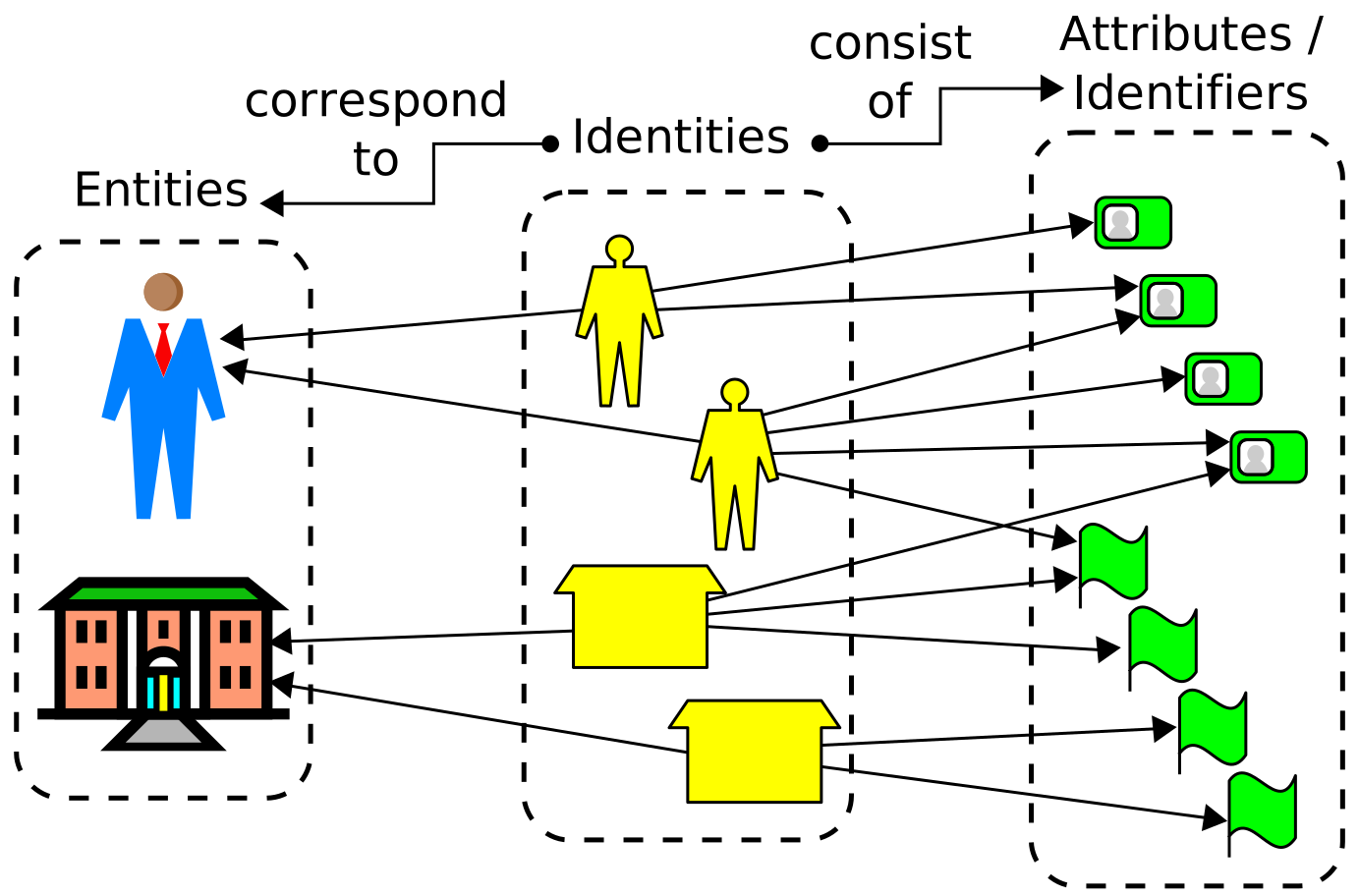
Historically, identity verification in decentralized finance relied on centralized intermediaries or opaque scoring systems. An OnChain Passport changes this by leveraging Proof of Personhood principles. Users gather "stamps" of verification from various sources—such as social connections, device history, or government IDs—and aggregate them into a decentralized identity (DID). This data remains under the user’s control, stored locally or on-chain only as necessary.
Minting the passport on-chain creates a permanent, immutable record. As noted in the Human Passport documentation, this step is required for applications that fetch passport data directly from the blockchain, ensuring the integrity of the verification process. This mechanism protects against Sybil attacks and bad actors, providing a robust layer of security for both users and protocol developers.
For legal and regulatory audiences, the OnChain Passport offers a promising path toward compliant DeFi. It allows for granular, user-consented sharing of compliance data. Instead of submitting full KYC documents to every platform, a user can present a cryptographic proof of their status. This reduces friction while maintaining the audit trails required by regulators.
Why DeFi Needs OnChain Verification
The decentralized finance (DeFi) ecosystem faces a structural paradox: it requires open access but demands strict identity verification to function within legal frameworks. Traditional centralized exchanges solve this by holding user data, but DeFi protocols operate without custodians. This gap creates vulnerability to Sybil attacks—where bad actors create thousands of fake identities to drain liquidity or manipulate governance votes—and exposes platforms to regulatory scrutiny regarding money laundering and terrorist financing.
OnChain Passport addresses this by introducing self-sovereign identity (SSI) directly into the blockchain layer. Instead of uploading sensitive documents to a central server, users accumulate verifiable credentials through trusted providers. These credentials are stored in a decentralized manner, allowing users to prove eligibility for a specific protocol without revealing their underlying personal data. This mechanism ensures DeFi compliance while preserving user privacy and data ownership.
Official documentation from Human Passport highlights the tool’s role in protecting the ecosystem from bad actors both onchain and offchain. By leveraging these tools, protocols can implement "Proof of Personhood" checks that are resistant to fraud. Similarly, platforms like VerifyInvestor’s On-ChainPass demonstrate how tokenized investor verification can eliminate repetitive paperwork. These solutions allow for seamless compliance checks that do not require manual intervention for every transaction, reducing operational risk for institutions and individual users alike.
The shift toward self-sovereign identity is not merely a technical upgrade; it is a regulatory necessity. As global standards for digital assets tighten, the ability to prove identity without surrendering control of one’s data becomes the standard for sustainable DeFi growth.
How Stamps Build OnChain Reputation
OnChain Passport transforms abstract digital activity into a verifiable, portable identity through a mechanism known as "stamps." These stamps are cryptographic proofs of identity, residency, or on-chain history that users collect from various providers. Unlike traditional databases that store personal information centrally, this system relies on self-sovereign identity principles, allowing users to maintain control over their data while proving their standing to decentralized applications.
The process begins with the aggregation of these stamps. Users interact with identity providers—ranging from government ID verification to proof-of-humanity checks—and receive signed attestations. These attestations are then bundled into a portable credential. This structure ensures that the reputation score is not locked into a single platform but can be presented across multiple DeFi compliance interfaces, creating a unified standard for trust.
Once aggregated, the stamps are submitted to a smart contract or verified via an off-chain verifier that checks the cryptographic signatures against the source providers. The resulting score reflects the density and quality of the proofs. A higher concentration of verified stamps indicates a more robust identity, reducing the risk of Sybil attacks and enhancing the security of the underlying DeFi protocols.

This architecture allows for a granular approach to DeFi compliance. Instead of a binary "verified/not verified" status, protocols can set thresholds based on specific stamp types. For instance, a high-value lending protocol might require proof of residency and a minimum on-chain transaction history, while a lower-risk application might only require proof of humanity. This flexibility is critical for regulatory adherence, as it allows institutions to tailor their risk assessments to the specific nature of the interaction.
The technical integration of this data is standardized, enabling developers to query stamp data programmatically. As noted in the Human Passport documentation, integrating on-chain stamp data allows applications to dynamically adjust user experiences based on their verified reputation. This creates a seamless link between identity verification and functional access, ensuring that only qualified users can participate in specific financial activities.
Leading OnChain Passport Solutions
The self-sovereign identity landscape for DeFi compliance is defined by three primary architectures. These solutions differ in their approach to data sovereignty, verification mechanics, and target regulatory environments. Understanding these distinctions is essential for institutions selecting an OnChain Passport provider.
| Provider | Primary Use Case | Data Sovereignty Model | Target Audience | | :--- | :--- | :--- | :--- |n| Human Passport | Proof of Personhood & Sybil Resistance | Decentralized, user-held | Web3-native protocols, airdrop protection | | Tokeny ONCHAINID | Institutional Investor Verification | Centralized registry with user consent | Regulated asset issuers, traditional finance | | VerifyInvestor On-ChainPass | Tokenized Investor Identity | Blockchain-based immutable ledger | Cross-border securities, compliance automation |
Human Passport, formerly Gitcoin Passport, operates as a decentralized identity verification tool. It aggregates Web2 and Web3 authentication methods to create a verifiable score. This model prioritizes privacy and protects against Sybil attacks, making it the standard for onchain governance and fair participation in Web3 ecosystems. Its architecture ensures users retain full control over their identity data without relying on a central authority.
Tokeny’s ONCHAINID takes a more traditional approach tailored for regulated markets. It functions as a self-managed investment passport that streamlines KYC/AML processes for institutional investors. By allowing users to reuse verified digital identity across multiple platforms, it reduces friction for asset issuers dealing with compliant capital. The solution bridges the gap between traditional compliance requirements and blockchain-based asset management.
VerifyInvestor’s On-ChainPass offers a blockchain-based verification system designed to eliminate repetitive paperwork. It creates a tokenized investor passport that remains immutable and portable. This solution is particularly effective for cross-border securities and automated compliance workflows, where regulatory adherence must be verifiable without manual intervention. It focuses on efficiency and auditability for high-volume transaction environments.
The Future of Cross-Chain Identity
The trajectory of DeFi compliance is shifting from isolated verification to interoperable, cross-chain identity. As the ecosystem matures, the OnChain Passport is evolving from a niche utility into essential infrastructure, enabling seamless regulatory adherence across fragmented blockchain networks. This transition addresses the historical friction where identity verification required redundant, chain-specific proofs, creating bottlenecks for institutional adoption.
Interoperability standards are emerging to allow a single self-sovereign identity credential to be recognized across multiple ledgers. By leveraging decentralized identifiers (DIDs) and verifiable credentials, users can maintain privacy while proving compliance status to any compliant protocol. This technical shift reduces the cognitive load on users and ensures that regulatory checks are not siloed within a single ecosystem, but rather portable and persistent.
Regulatory acceptance is accelerating this change. Authorities are increasingly looking for standardized, auditable identity layers that integrate with existing financial compliance frameworks like KYC/AML. The OnChain Passport provides this bridge, offering a structured data layer that regulators can trust without exposing unnecessary personal data. This alignment transforms identity from an optional feature into a foundational requirement for sustainable DeFi growth.
Common Questions About OnChain Identity
Clarifying terminology and mechanics is essential for integrating self-sovereign identity into compliant workflows. The following questions address specific queries regarding OnChain Passport, wallet interoperability, and verification benefits.
Understanding these distinctions ensures that legal and compliance teams select the correct tools for DeFi compliance. OnChain Passport is not a wallet but a verification layer that can be integrated into various non-custodial wallets and applications.
No comments yet. Be the first to share your thoughts!