
Defining the OnChain Passport
An OnChain Passport functions as a verifiable credential system, distinct from both physical travel documents and standard blockchain wallet addresses. It serves as a digital identity layer designed for compliance within decentralized finance (DeFi) protocols, rather than facilitating international border crossings or serving as a generic address label. By anchoring identity verification on-chain, the system allows users to prove eligibility for financial services without revealing unnecessary personal data to third-party intermediaries.
The architecture relies on the Ethereum Attestation Service (EAS) to create immutable attestations of identity data. This approach transforms static wallet addresses into dynamic, compliant entities. According to Human Protocol documentation, the OnChain Passport uses EAS to generate these verifiable credentials, ensuring that the attestation is cryptographically secure and publicly auditable [src-serp-1]. This mechanism aligns with regulatory requirements for Know Your Customer (KYC) and Anti-Money Laundering (AML) checks, enabling protocols to filter participants based on verified status.
Unlike traditional passports, which are issued by sovereign states for travel, the OnChain Passport is a permissionless but regulated tool for financial participation. It does not replace physical identification for legal travel purposes but operates within the specific scope of blockchain-based asset management and investment compliance. Users maintain ownership of their data through self-managed credentials, reusing the same verified identity across multiple DeFi applications that support the standard.
The distinction is critical for high-stakes financial operations. Standard wallet addresses offer no proof of identity, leaving protocols exposed to regulatory risk. An OnChain Passport provides the necessary audit trail for institutional and retail participants alike, bridging the gap between anonymous blockchain activity and regulated financial standards.
How the Ethereum Attestation Service works
The transition from off-chain identity verification to on-chain record-keeping relies on the Ethereum Attestation Service (EAS). This infrastructure allows decentralized identity protocols, such as Human Passport, to anchor verified user data onto the Ethereum blockchain without storing sensitive personal information directly on-chain. The process ensures that identity claims are immutable, cryptographically signed, and universally verifiable by compliant smart contracts.

The process begins with the user completing off-chain identity checks. Verification providers, such as Sumsub or Onfido, validate the user's credentials against government-issued documents. Once verified, the protocol generates a "Stamp" or score. This step ensures that the data being attested is grounded in real-world identity, satisfying Know Your Customer (KYC) requirements without exposing raw PII on the public ledger.

The verified identity data is structured into a specific schema defined by the EAS protocol. A trusted attester, typically the identity protocol's smart contract, signs this data. This signature cryptographically links the attester's identity to the data payload, creating a verifiable attestation. The attestation includes the schema ID, the recipient's address, and the timestamp, ensuring the record is tamper-proof and time-stamped on the Ethereum network.

The signed attestation is submitted to the Ethereum blockchain via a transaction. EAS records this event, making it permanently available for query. Because the blockchain is a public ledger, any compliant smart contract can verify the attestation's validity by checking the attester's signature against the EAS registry. This eliminates the need for centralized databases to confirm identity status, reducing single points of failure and regulatory liability.

DeFi protocols and regulated entities query the EAS registry to verify a user's identity status. Smart contracts can automatically enforce compliance rules, such as restricting access to certain tokens or features based on the attestation's data. This automation ensures that only verified users can interact with regulated financial products, aligning on-chain activity with off-chain legal requirements.
This mechanism provides a regulatory-grade solution for DeFi identity. By leveraging EAS, protocols can maintain a clear audit trail of identity verification events, ensuring that compliance is not just a policy but a programmable, verifiable state on the blockchain.
Why DeFi protocols need verified identity
The regulatory environment for decentralized finance has shifted from theoretical scrutiny to enforced compliance. In 2026, the era of anonymous wallets operating without oversight is effectively over. Major jurisdictions, including the European Union under the Markets in Crypto-Assets (MiCA) regulation and the United States via FinCEN guidance, now treat decentralized protocols as virtual asset service providers (VASPs) when they facilitate fiat on-ramps or offer regulated financial products. This classification imposes a legal obligation on protocols to prevent financial crimes, including money laundering and terrorist financing.
For DeFi protocols, this regulatory pressure translates into a technical requirement for verified identity. Without a robust identity layer, protocols cannot satisfy "Travel Rule" requirements, which mandate that certain information travels with the transaction. A protocol that fails to verify user identity risks being blacklisted by centralized banking partners, losing liquidity, or facing direct legal action. Verified identity is no longer optional for high-stakes DeFi; it is the primary mechanism for legal interoperability between traditional finance (TradFi) and decentralized networks.
Tokenized investor passports, such as On-ChainPass, address this by creating a reusable, privacy-preserving proof of compliance. Instead of submitting sensitive documents to every individual protocol, users undergo verification once. The resulting identity token is stored on-chain as a zero-knowledge proof or a signed attestation. This allows protocols to instantly confirm that a user has passed Know Your Customer (KYC) and Anti-Money Laundering (AML) checks without storing the personal data themselves. This architecture reduces liability for the protocol while ensuring that only compliant users can access regulated DeFi services, such as tokenized securities or yield-bearing stablecoins.
The integration of verified identity also protects the broader ecosystem. By filtering out sanctioned addresses and illicit actors, protocols maintain their license to operate. As regulatory bodies increasingly target the infrastructure layer rather than just the end users, the adoption of identity verification becomes a critical component of protocol design. Protocols that ignore this shift will find themselves unable to onboard institutional capital or integrate with traditional financial rails, effectively isolating themselves from the mainstream economy.
Comparing OnChain Passport providers
Selecting the appropriate identity verification protocol requires aligning technical architecture with specific regulatory obligations. While the underlying goal—proving human status or investor accreditation without exposing unnecessary personal data—remains consistent, the implementation varies significantly across the market. The choice between a consumer-facing reputation system and an institutional-grade compliance tool depends on whether the primary constraint is user acquisition or legal defensibility.
The following comparison evaluates three distinct approaches to on-chain identity, focusing on data ownership models, target audiences, and the underlying verification mechanisms that satisfy compliance frameworks.
| Provider | Primary Use Case | Data Ownership | Verification Basis |
|---|---|---|---|
| Human Passport | Retail & DeFi Access | User-held (ZK Proofs) | Social graph & activity stamps |
| Tokeny ONCHAINID | Institutional & STO | Self-managed reusable | KYC/AML checks + wallet history |
| Verify Investor On-ChainPass | Tokenized Securities | Tokenized credentials | Blockchain-based investor status |
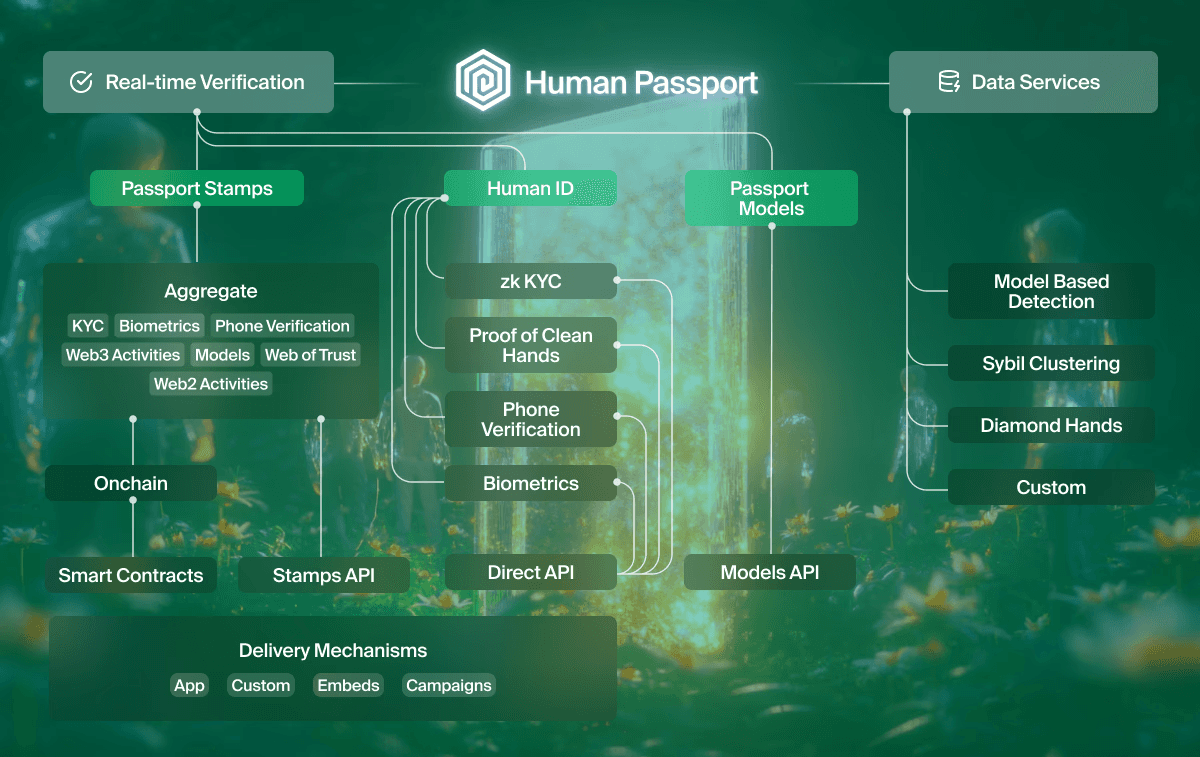
Human Passport operates primarily as a reputation layer for decentralized applications. It aggregates various "stamps" of human activity to generate a unique humanity score. This model prioritizes user privacy through zero-knowledge proofs, allowing users to prove they are human without revealing their identity to the dApp. It is best suited for retail environments where friction reduction and broad accessibility are the primary goals, though it offers limited utility for strict regulatory compliance such as KYC.
Tokeny’s ONCHAINID is designed for high-stakes financial instruments, particularly Security Token Offerings (STOs). It functions as a reusable, self-managed passport that stores verified identity data on-chain. This approach satisfies institutional requirements for auditability and regulatory adherence (such as MiCA or SEC guidelines) while allowing the user to control the reuse of their verified status across different platforms. The focus here is on legal defensibility and seamless onboarding for accredited investors.
Verify Investor’s On-ChainPass takes a similar institutional approach but emphasizes the tokenization of the verification status itself. By converting investor credentials into a blockchain-based token, it eliminates repetitive paperwork for issuers. This model is particularly effective for platforms issuing tokenized securities, where the verification status must be programmatically enforced and transferred alongside the asset. It bridges the gap between traditional legal due diligence and on-chain programmability.
Steps to mint your first OnChain Passport
Minting an OnChain Passport establishes a verifiable credential on the Ethereum blockchain using the Ethereum Attestation Service (EAS). This process transforms your accumulated Gitcoin Passport reputation into a cryptographic attestation, enabling compliance with decentralized finance (DeFi) protocols that require proof of identity or eligibility.
Begin by connecting your Web3 wallet to the OnChain Passport dashboard. The system will automatically query your Gitcoin Passport score via the underlying API. Ensure your score meets the minimum threshold required by your target protocol before proceeding, as the attestation process cannot create reputation that does not already exist in your profile.
Before finalizing, review the specific attestation parameters. The interface displays the EAS schema being used and the associated gas costs for the transaction. This step is critical for compliance verification; ensure the attestation includes the correct identity attributes required by the regulatory framework of the target DeFi application.
Sign and submit the transaction from your connected wallet. Once confirmed on the Ethereum mainnet, your passport data is immutably recorded as an attestation. This on-chain record serves as your verifiable credential, which can now be presented to compliant DeFi platforms for identity verification without exposing raw personal data.
For further technical specifications regarding the EAS schema and attestation structures, refer to the official OnChain Passport documentation.
Common mistakes when verifying identity
Verifying identity on-chain requires strict adherence to protocol-specific constraints. The most frequent error involves over-sharing personally identifiable information (PII). Users often assume that uploading sensitive documents directly to a decentralized identity provider constitutes secure verification. This is incorrect. Verification relies on zero-knowledge proofs or selective disclosure mechanisms that attest to data validity without exposing the underlying document. Exposing raw PII on public ledgers or unencrypted storage creates permanent privacy liabilities that contradict self-sovereign identity principles.
Another critical pitfall is ignoring gas costs and network congestion. Minting an on-chain attestation is not always free. Depending on the Ethereum Layer 2 solution or base layer used, transaction fees can fluctuate significantly. Users who fail to maintain sufficient native token balances for gas will find their verification process stalled. This is particularly relevant when interacting with the Ethereum Attestation Service, where successful attestation requires a completed on-chain transaction.
Finally, users frequently misunderstand the revocation and update processes. Unlike traditional centralized databases, on-chain records are immutable. If a user’s identity status changes or a credential is compromised, the existing attestation remains valid unless explicitly revoked or superseded. Users must understand the specific protocol’s mechanism for credential invalidation. Failure to do so can result in using outdated or invalid identity proofs for regulated financial actions.
Frequently asked questions about onchain identity verification
The following queries address common misconceptions regarding the technical architecture, security implications, and regulatory standing of onchain identity systems.
How does an onchain passport differ from a hardware wallet?
A hardware wallet functions as a secure key management device, storing private keys offline to authorize transactions. An onchain passport, by contrast, is a verifiable credential system. As documented by Human Protocol, the onchain passport utilizes the Ethereum Attestation Service (EAS) to create a cryptographic attestation of your identity data on the blockchain [src-serp-1]. While a wallet proves ownership of assets, an onchain passport proves the authenticity of the entity behind those assets, often integrating with tools like Tokeny’s ONCHAINID to manage reusable investment credentials [src-serp-2].
Are digital passports a replacement for physical travel documents?
No. Current digital identity implementations in the crypto and fintech sectors are not recognized as valid travel documents for border control. While some jurisdictions allow digital IDs in wallets for specific domestic security checkpoints, they cannot perform the functions of a physical passport, such as international travel or border crossing [src-serp-2]. Onchain identity is primarily designed for decentralized finance (DeFi) compliance, such as KYC/AML verification for protocol access, rather than sovereign travel authorization.
How is personal data privacy maintained on a public ledger?
Onchain identity systems are designed to minimize data exposure by storing only cryptographic hashes or attestations on the blockchain, rather than raw Personally Identifiable Information (PII). The actual data remains off-chain or in encrypted storage, with the onchain component serving as a verifiable proof of compliance. This approach aligns with regulatory expectations for data minimization, ensuring that identity verification can be conducted without exposing sensitive user details to the public network.
No comments yet. Be the first to share your thoughts!