
Why identity matters in crypto
For years, the crypto industry operated on a simple premise: your wallet address is your identity. This pseudonymous model allowed for permissionless participation but created a significant barrier for institutional capital and compliant retail adoption. Banks and traditional financial institutions cannot onboard clients into decentralized finance (DeFi) protocols without knowing who sits behind the private keys. The shift from anonymous wallets to verified real-world identity is not just a regulatory preference; it is a technical prerequisite for the next wave of mainstream financial infrastructure.
The OnChain Passport 2026 framework addresses this gap by linking verified legal identities to blockchain addresses without exposing sensitive personal data on public ledgers. This approach, often referred to as a blockchain passport, allows users to prove compliance attributes—such as accreditation status or geographic residency—while maintaining control over their core data. As noted by industry solutions like Tokeny’s ONCHAINID, this creates a reusable, self-managed identity layer that can be leveraged across multiple DeFi applications, reducing friction and duplication of effort. [src-serp-1]
Note: Regulatory pressure is accelerating the adoption of verifiable credentials. In 2026, compliance is no longer optional; it is the gatekeeper for institutional liquidity and large-scale DeFi participation.
This transition transforms digital identity from a static credential into a dynamic, programmable asset. By guaranteeing asset ownership and user identity through cryptographic proofs, the ecosystem can offer the privacy of crypto with the accountability of traditional finance. This duality is essential for unlocking the full potential of decentralized markets, ensuring that access is open to all compliant participants while remaining secure and regulated.
How OnChain Passports work
An OnChain Passport moves your identity data from a private app to the public blockchain. Instead of keeping your score in a siloed database, the system mints a verifiable credential that anyone can check. This process relies on the Ethereum Attestation Service (EAS), which acts as the ledger for your digital reputation.
The mechanism is straightforward: you collect off-chain proofs, known as stamps, and then submit them to the network. These stamps verify specific attributes about you, such as your account age or device security. Once verified, these attestations are bundled into a single credential on-chain. This makes your identity portable and resistant to censorship, as the data lives on Ethereum rather than a company server.

You start by linking your various online accounts to your passport app. The system requests proofs, or stamps, from these services. These stamps confirm that you control specific email addresses, social profiles, or financial accounts without revealing the underlying data to the public.

The app aggregates these stamps to calculate a reputation score. This score reflects the strength and diversity of your digital footprint. A higher score indicates a more established and secure identity, which is often required for accessing certain DeFi protocols or airdrops.
You submit your verified score to the Ethereum Attestation Service. EAS creates a signed attestation that links your wallet address to your reputation data. This step is usually a one-time transaction, after which your credential is permanently recorded on the blockchain.

Smart contracts can now read your on-chain attestation to verify your identity. Instead of asking for KYC documents, a DeFi protocol checks the EAS record to confirm you meet their requirements. This allows for permissionless access to financial services based on your proven reputation.
The choice of EAS is critical for the integrity of the system. Because EAS is a decentralized standard, it ensures that no single entity can alter or delete your attestation. This permanence is what transforms a simple app score into a true digital passport.
Leading onchain passport providers
The onchain identity market is fragmenting into distinct categories based on who needs to verify the user and what data is required. While some solutions prioritize consumer accessibility through social graph analysis, others focus on institutional compliance with strict regulatory frameworks. Choosing the right provider depends on whether your primary goal is user acquisition or legal adherence.
Consumer-Focused: Human Passport
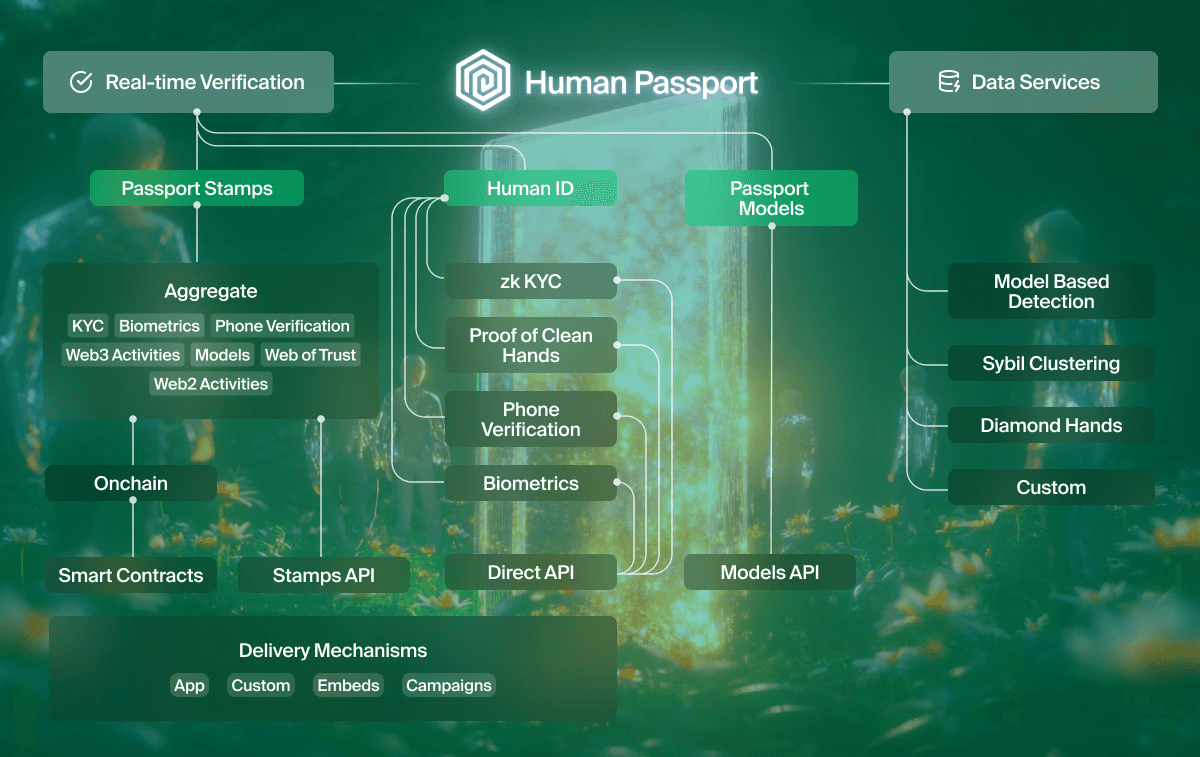
Human Passport, developed by Gitcoin, targets the broad consumer market. It operates as a proof-of-humanity protocol, assigning a "Unique Humanity Score" based on the accumulation of verification "stamps" from various services. This approach is designed to deter sybil attacks (bot networks) rather than verify legal identity. It is ideal for decentralized applications (dApps) that need to distribute tokens or access to real humans without collecting sensitive personal data.
Institutional Compliance: Tokeny ONCHAINID
Tokeny ONCHAINID is built for regulated financial environments. It functions as a self-managed, reusable investment passport that integrates directly with KYC (Know Your Customer) and AML (Anti-Money Laundering) workflows. Unlike consumer tools, it focuses on validating legal identity to meet jurisdictional requirements. This makes it the standard for tokenized securities, where issuers must prove the investor is accredited or located in an approved region.
Hybrid Verification: Verify Investor
Verify Investor offers a middle ground with its On-ChainPass solution. It provides a blockchain-based investor verification that eliminates repetitive paperwork while maintaining a level of rigor suitable for both retail and institutional investors. It bridges the gap by offering a reusable credential that can be presented across multiple platforms, reducing friction for users who interact with both compliant and non-compliant DeFi protocols.
Provider Comparison
The table below compares the three leading providers on verification type, target audience, and primary blockchain integration.
| Provider | Primary Focus | Target Audience | Verification Type |
|---|---|---|---|
| Human Passport | Sybil Resistance | Web3 Consumers | Social Graph / Stamps |
| Tokeny ONCHAINID | Regulatory Compliance | Institutions / Issuers | Legal KYC / AML |
| Verify Investor | Reusable Credentials | Hybrid (Retail & Institutional) | On-Chain Passport |
Build your onchain reputation
Your OnChain Passport score is not a static certificate; it is a cumulative record of trust signals. You build this reputation by collecting "stamps" from Human Passport, which verify different layers of your digital life. The process rewards consistency and diversity of activity over time.
Start by connecting your wallet to the Human Passport dashboard. The platform automatically analyzes your onchain history against known human patterns and Sybil attacks. For example, the ETH Activity Stamp alone is worth 22 points, effectively proving you are an on-chain OG rather than a bot. This is often the highest-yield stamp for early adopters because it leverages history you already have.
To reach a competitive score, you must diversify beyond Ethereum. Link your GitHub, Twitter, or Discord to prove your off-chain presence. Each verified stamp adds a layer to your verifiable identity. Once your stamps are collected, you can mint them on-chain to store your score permanently. This onchain functionality ensures your reputation travels with you across DeFi protocols.
-
Connect wallet to Human Passport dashboard
-
Verify ETH activity for the 22-point Stamp
-
Link at least two off-chain social accounts
-
Mint stamps on-chain to finalize reputation
Common pitfalls in identity verification
Onchain identity sounds permanent, but it is not always as forgiving as a traditional credit report. Once you connect a wallet to an app or sign an attestation, that data lives on the blockchain. If you make a mistake, you cannot simply call customer support to reverse it. Understanding where things go wrong is the only way to protect your digital reputation.
Privacy leaks and data exposure
Your wallet is your passport in Web3, acting as the primary way you access apps and prove who you are. However, this visibility is a double-edged sword. Every transaction is public, linking your activity to a single address. If you link your real-world identity to that address through a KYC provider or a social login, you have effectively created a permanent, searchable profile. Many users fail to realize that their "anonymous" activity is now tied to their legal name, exposing them to targeted attacks or unwanted scrutiny.
Sybil attacks and fake identities
Not everyone you interact with online is who they claim to be. Sybil attacks occur when a single user creates multiple fake identities to manipulate a system, such as voting on a DAO proposal or claiming airdrops disproportionately. If you rely on weak verification methods, you might accidentally trust a bot or a malicious actor. This is why many protocols now require "proof of personhood" or unique soulbound tokens to ensure that one person equals one vote. Ignoring these safeguards can lead to compromised governance or financial loss.
The irreversibility of attestations
Attestations are digital credentials that verify specific traits, like your credit score or employment status. The danger lies in their permanence. If you issue an attestation with incorrect information, or if your status changes (like losing a job) but you fail to revoke the old credential, the false data remains on-chain. Other apps may read this outdated information, leading to rejected applications or frozen assets. Always review the scope and expiration dates of any attestation you sign before committing to it.
No comments yet. Be the first to share your thoughts!