
In a world where your digital footprint is harvested by corporations and governments alike, self-sovereign identity (SSI) emerges not as a buzzword, but as a radical reclamation of personal agency. For users of decentralized identity (DID) wallets, SSI transcends the shallow promise of anonymity; it delivers granular control over what you share, with whom, and for how long. Imagine proving you're over 18 without flashing your birthdate or verifying employment without surrendering your resume. This is the true power of SSI, powered by blockchain and zero-knowledge proofs, reshaping how we interact online.
Decoding the Core of Self-Sovereign Identity
At its heart, SSI flips the script on traditional identity systems dominated by centralized providers like Google or banks. Instead of storing your data in vulnerable silos, SSI lets you generate and manage unique Decentralized Identifiers (DIDs) tied to your DID wallet. These DIDs are resolvable on blockchains or distributed networks, ensuring no single entity holds the reins.
But here's where many falter: decentralization alone doesn't guarantee privacy. Public blockchains expose DIDs and associated verifiable credentials (VCs) to prying eyes, leaking patterns that could deanonymize you. Enter zero-knowledge (ZK) technology, the linchpin of meaningful SSI. ZK proofs allow you to attest facts - like 'I hold a valid passport' - without revealing the passport details. This selective disclosure is SSI's killer feature for DID wallet users seeking decentralized identity wallets control.
Recent global strides underscore this shift. China's RealDID system, launched in 2023, mandates real-name registration yet preserves service-provider anonymity through private keys. Meanwhile, the EU's EUDI Wallet under eIDAS 2.0 promises cross-border access to services with user-controlled data. These aren't hypotheticals; they're proof that SSI scales from individual wallets to national infrastructure.

SSI Misconceptions and the ZK Imperative for DID Wallets
One pervasive myth in the SSI discourse is that any blockchain-based ID is inherently private. Far from it. Without ZK proofs, DIDs on public ledgers become correlation nightmares - public keys link to transactions, VCs reveal attributes, and heuristics unravel your pseudonymity. I've seen projects tout 'decentralized' identities that are anything but sovereign, as they inadvertently broadcast user graphs ripe for surveillance.
SSI Misconceptions Debunked
- 1. Decentralization equals privacyDecentralization via blockchain reduces central points of failure but doesn't guarantee privacy. Public ledgers expose DIDs and VCs, requiring zero-knowledge (ZK) proofs for selective disclosure without revealing data. (Source: ChainScore Labs, House of ZK)
- 2. DIDs are fully anonymousDecentralized Identifiers (DIDs) are pseudonymous, linking activities across interactions via the same DID. True anonymity needs additional layers like ZK proofs to prevent correlation. (Source: Wikipedia SSI, Medium SSI Wallets)

- 3. VCs can't leak dataVerifiable Credentials (VCs) on public blockchains reveal metadata or full data without proofs. ZK proofs enable verification without exposure, preventing leaks. (Source: Wiley ZKPs, zkrollups.io)
- 4. Wallets alone sufficeSSI wallets manage DIDs/VCs but require interoperability standards like DID methods and VC formats for cross-platform use, as in EUDI Wallet or China RealDID. (Source: Wikipedia SSI, Dock Labs)
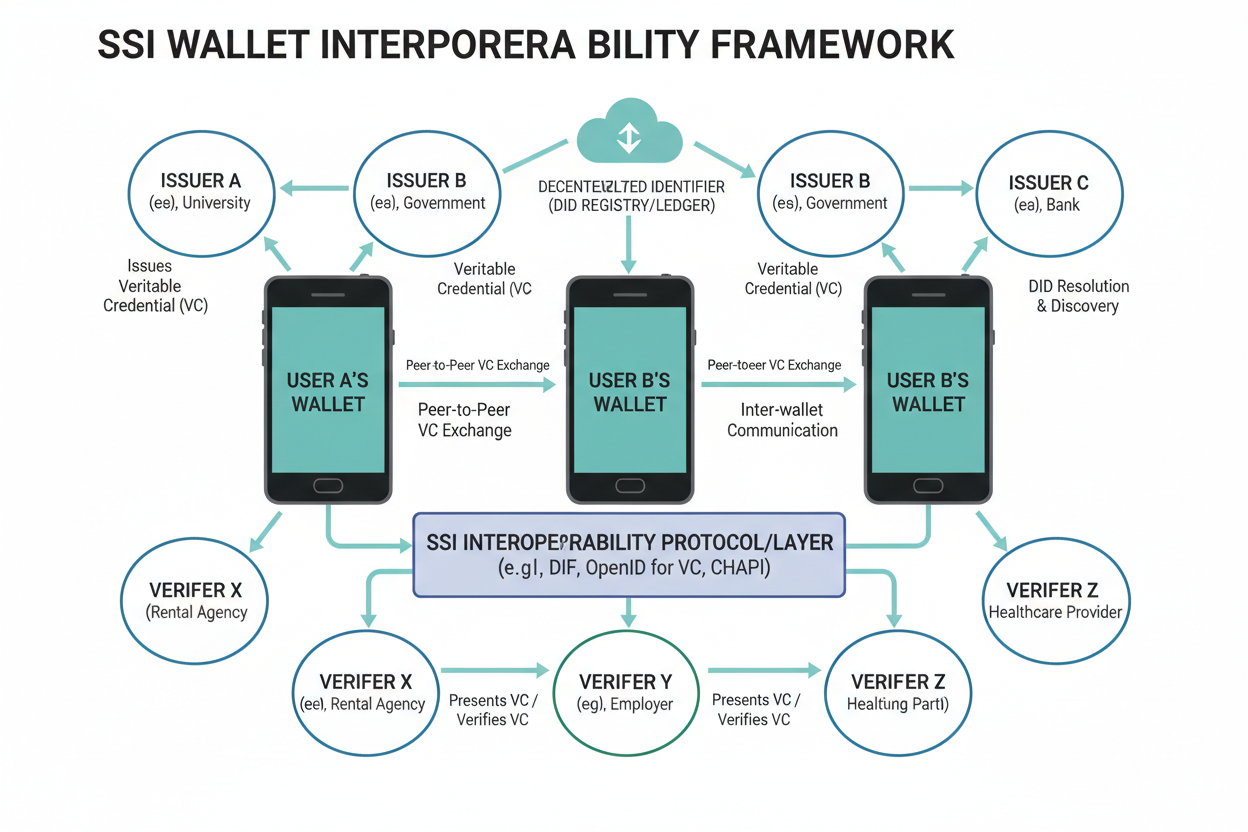
True self-sovereign ID zk technology demands wallets that integrate zk-SNARKs or similar primitives. Tools like Orion exemplify this, proving computations without exposing inputs. For DID wallet users, this means transacting in social media, payments, or KYC without residue. ChainScore Labs nails it: ZK is the only path to private identity amid blockchain transparency.
Mastering DID Wallets: From Keys to Verifiable Credentials
DID wallets aren't mere apps; they're fortresses for your identity stack. Each wallet generates a private key, deriving a public key and DID. This trio - private key for signing, public key for verification, DID for resolution - forms the backbone. Misunderstand this, and you're vulnerable; master it, and you orchestrate credentials like a conductor.
Verifiable credentials shine here. Issued by trusted entities (universities, governments), VCs are cryptographically signed JSON-LD objects stored offline in your wallet. Presentation happens on-demand: you prove attributes via ZK, revocable only by the issuer if policies allow. This setup empowers DID wallets verifiable credentials in real-world use, from age-gated logins to decentralized lending.
Picture a developer accessing a Web3 dApp: instead of OAuth handshakes exposing emails and profiles, they present a ZK-proof of 'skilled in Solidity' from a verified credential. Or a freelancer proving income thresholds for loans without baring bank statements. These scenarios aren't distant; they're unfolding as self-sovereign identity DID wallets mature.
Real-World Applications: SSI in Action Today
SSI's edge sharpens in high-stakes environments. Social media platforms strained by data scandals now experiment with ZK-enabled profiles, letting users prove follower authenticity or content age-appropriateness sans personal leaks. zkrollups. io highlights how ZK proofs reclaim privacy here, turning identity into a sovereign asset decoupled from servers.
Payments follow suit. Private stablecoin transactions, as detailed by PayRam, leverage ZKPs for compliance in regulated sectors. Merchants verify customer location or transaction limits without full KYC dumps. For DID wallet users, this means fluid commerce minus surveillance residue.
Governments lead too. Beyond China's RealDID balancing anonymity with real-name mandates, the EU's EUDI Wallet rollout targets 2026, enabling seamless service access across borders. Citizens control attribute sharing, revoking access post-use. These systems prove SSI's scalability, blending sovereignty with interoperability.
Traditional Identity vs. SSI with ZK Proofs: Key Differences
| Aspect | Traditional Identity | SSI with ZK Proofs |
|---|---|---|
| Centralized Authority | Yes (governments, corporations control issuance and verification) | No (decentralized via DIDs and blockchain; user sovereign) |
| Data Storage | Centralized databases (vulnerable honeypots) | User-controlled wallets (decentralized, no central storage) |
| Privacy Mechanism | Limited; full disclosure or pseudonyms often linked to real data | Zero-Knowledge Proofs (ZKPs) enable selective disclosure without revealing underlying data |
| User Control | Low; third parties manage and access data | Full ownership; users control DIDs, VCs, and sharing |
| Breach Risk | High (single point of failure for mass data exposure) | Low (distributed control, ZKPs prevent data leakage) |
Yet adoption hinges on usability. Early SSI wallets demanded crypto fluency; today's prioritize intuitive interfaces, biometric secures, and multi-chain support. Developers must prioritize standards like DIDComm for messaging and Verifiable Data Registries for resolution.
Navigating Challenges: Pitfalls and Paths Forward for DID Users
SSI isn't flawless. Interoperability gaps plague ecosystems; a VC from one issuer may falter elsewhere without universal schemas. Revocation remains tricky - issuers hold power, potentially undermining sovereignty. Reddit threads like r/ethereum's Proof of Humanity critique reveal user wariness: privacy promises often carry fine-print terms.
Blockchain scrutiny amplifies risks. Public chains invite analysis; without ZK, transaction graphs expose habits. ChainScore Labs warns that 'decentralized' DIDs leak via heuristics. My stance: shun non-ZK wallets. Demand zk-SNARKs or STARKs for proofs that conceal while convincing.
Regulatory headwinds loom. While eIDAS 2.0 embraces SSI, others mandate traceability, clashing with pure sovereignty. Users counter by layering privacy: off-chain storage, ephemeral DIDs, selective chains. Discipline here pays; sloppy setups invite deanonymization.
Future-proofing demands vigilance. Watch projects fusing SSI with AI for dynamic credentials or L2s for cheap proofs. House of ZK's latest notes human. tech's push for SSI control. As portfolio manager, I see parallels: diversify identity vectors like assets, hedging against single points of failure.
For DID wallet users, SSI redefines digital existence. It equips you to navigate a surveilled web with precision, sharing just enough to thrive. Embrace ZK-integrated tools, master your stack, and claim the control corporations long denied. Your identity, your rules - secured eternally on-chain.



No comments yet. Be the first to share your thoughts!