
In an era where digital interactions demand ironclad privacy, zk identity wallets emerge as a game-changer, allowing users to generate self-sovereign identity proofs without exposing their wallet details. Traditional blockchain wallets force users to reveal addresses or signatures, risking linkage to personal data. Zero-knowledge proofs invert this vulnerability: you prove attributes like age over 18 or residency in a specific region mathematically, sans disclosure. This shift empowers true self-sovereignty, aligning with decentralized identifiers (DIDs) and verifiable credentials in zk format.
Consider the stakes. As Ethereum trades at $1,861.40, down 6.04% in the last 24 hours from a high of $1,981.94, the blockchain underpins these innovations remains resilient. Developers leverage its layer-2 solutions for scalable zk computations, fueling adoption among privacy advocates and institutions alike.
Decoding Zero-Knowledge Proofs for Walletless Verification
At the core of decentralized identity zk proofs lie zk-SNARKs and zk-STARKs, cryptographic primitives that verify statements without input revelation. Imagine proving KYC compliance: your wallet generates a proof attesting verification by a trusted issuer, shareable across dApps without wallet exposure. Polygon ID exemplifies this, using BBS and signatures for selective disclosure, where users reveal only necessary claims from credentials.
This mechanism reduces identity risk dramatically. No longer must creators expose civil details; proofs establish origin and integrity independently. Platforms like zkMe extend this with multi-party computations, ensuring trustless infrastructure for compliance-heavy sectors like finance and healthcare.
Traditional wallets often require full disclosure to gain access, but zk identity wallets flip this paradigm. Users hold verifiable credentials. . .
Self-Sovereign Identity Wallets Reshaping Web3 Onboarding
DID wallets zero knowledge integrate seamlessly into ecosystems like Polygon and Ethereum, enabling one-tap DID generation and proof issuance. Altme wallet, paired with PolygonID, lets users manage ZK credentials for private smart contract interactions. This portability means a single proof verifies you for DeFi lending, NFT minting, or even AR glasses dietary confirmations, without centralized intermediaries touching data.

Market projections underscore the momentum: self-sovereign identity hits a $6.64 billion valuation by 2026, driven by zk tech. Traceva adds modular scalability, composing private experiences atop SSI foundations. ZKId pushes further with decentralized storage, ensuring proofs remain user-controlled indefinitely.
Ethereum (ETH) Price Prediction 2027-2032
Forecasts tied to zk Identity Wallet adoption and Self-Sovereign Identity market growth from 2026 baseline of ~$1,861
| Year | Minimum Price | Average Price | Maximum Price |
|---|---|---|---|
| 2027 | $1,800 | $3,000 | $5,500 |
| 2028 | $2,500 | $4,500 | $8,000 |
| 2029 | $3,000 | $6,500 | $12,000 |
| 2030 | $4,500 | $9,500 | $18,000 |
| 2031 | $6,000 | $13,000 | $25,000 |
| 2032 | $8,000 | $18,000 | $35,000 |
Price Prediction Summary
Ethereum is forecasted to experience strong growth from 2027-2032, driven by zk identity wallet proliferation and SSI market expansion to $6B+. Average prices are projected to rise from $3,000 to $18,000 (CAGR ~43%), with mins reflecting bearish corrections and maxes capturing mass adoption in DeFi, AR, and KYC use cases amid Ethereum's scaling advancements.
Key Factors Affecting Ethereum Price
- Explosive SSI market growth to $6.64B+ by 2026, boosting ETH ecosystem utility
- zk wallet integrations (Polygon ID, zkMe, ZKId) driving L2 transaction volume on Ethereum
- Privacy-preserving proofs enabling new Web3 applications in DeFi, AR/VR, and compliance
- Ethereum upgrades (e.g., scaling, ZK rollups) supporting higher throughput for identity solutions
- Regulatory tailwinds for decentralized identities reducing compliance barriers
- Crypto market cycles with potential 2028-2029 bull run amplifying adoption gains
- Macro factors like interest rates and institutional inflows via ETH ETFs
- Competition from L1/L2 rivals tempered by Ethereum's first-mover dominance in ZK tech
Disclaimer: Cryptocurrency price predictions are speculative and based on current market analysis. Actual prices may vary significantly due to market volatility, regulatory changes, and other factors. Always do your own research before making investment decisions.
Verifiable Credentials ZK: From Theory to Practical Deployment
Verifiable credentials zk transform static data into dynamic, privacy-preserving assets. Issuers sign claims off-chain; wallets store them encrypted. Verification happens on-chain via succinct proofs, slashing gas costs and latency. EUDI wallet compliance via SSI models this: distributed ledgers grant full credential control, verifiable instantly without KYB hurdles.
Operationally, integration simplifies. DApps query proofs directly; no API calls to custodians. This streamlines processes, from Web3 logins to regulatory nods, fostering a future where privacy scales with utility. As Ethereum holds at $1,861.40, investment flows into these tools signal maturity, bridging TradFi caution with blockchain's bold privacy ethos.
Yet challenges persist: proof generation demands computational heft, though layer-2s mitigate this. User education lags, but wallets like those from onchainpassport. org guides bridge the gap, empowering blockchain enthusiasts and developers alike.
Layer-2 advancements, such as those on Polygon and Ethereum scaling solutions, compress proof sizes and accelerate verification, making zk identity wallets viable for everyday use. Polygon ID's mobile-first approach, with one-tap SNARK issuance, exemplifies this efficiency, while zkMe's multi-party computations add robustness for enterprise-grade deployments.
Key Platforms Driving zk Identity Adoption
ZKId stands out by pairing zero-knowledge proofs with decentralized storage, letting users prove attributes indefinitely without data leaks. Traceva layers modular scalability atop SSI, enabling composable privacy for dApps and private transactions. These tools address real-world friction: selective disclosure via BBS and signatures in Polygon ID means proving residency or accreditation without full credential dumps.
Top zk Identity Wallets 2026
- ZKId: Empowers self-sovereign identity via zero-knowledge proofs and decentralized storage for private proofs without data disclosure. zkid.digital
- Polygon ID: Mobile-first with one-tap SNARKs for DIDs, enabling seamless privacy-preserving verifications in Polygon ecosystem. onchainpassport.org
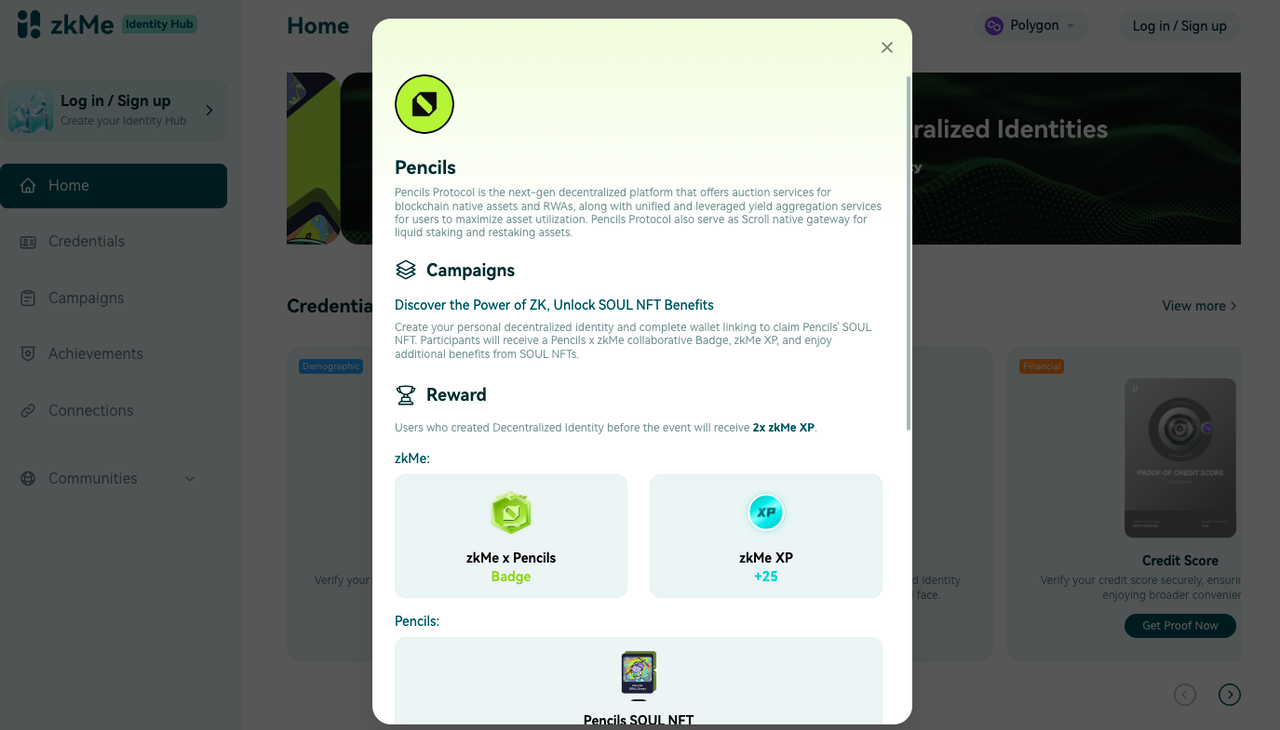
- zkMe: Trustless infrastructure using zero-knowledge proofs and multi-party computation for decentralized verification and compliance. blog.zk.me
- Traceva: Combines ZK cryptography, SSI, and modular scalability for portable self-sovereign IDs and private transactions. traceva.ai
- Altme: Supports ZK credential management, allowing Polygon users to claim and manage ZK credentials for private Web3 interactions. altme.io
Altme's integration with PolygonID empowers direct ZK credential handling in-wallet, smoothing Web3 interactions from DeFi to gaming. This ecosystem maturity reflects broader trends; as Ethereum stabilizes at $1,861.40 after dipping to a 24-hour low of $1,854.53, capital shifts toward privacy infrastructure, underscoring zk tech's resilience amid volatility.
Real-World Applications: ZK Proofs Beyond Finance
Decentralized identity zk proofs extend far past crypto-native use cases. In augmented reality, ZK proofs confirm dietary needs to a restaurant system without wallet or Meta intermediaries intervening. Healthcare benefits from origin proofs verifying credential integrity sans civil identity exposure, slashing fraud risks. Even EUDI wallets align with SSI, leveraging distributed ledgers for portable, compliant credentials across borders.
Operationally, these proofs streamline everything from NFT access gates to regulatory KYC. Instant verification bypasses intermediaries, cutting KYB timelines from days to seconds. DappRadar highlights zero-knowledge proofs as the vanguard of blockchain identity, mathematically affirming facts like accreditation without disclosure trails.
Critically, this paradigm demands pragmatic risk assessment. While zk-SNARKs offer succinctness, STARKs provide transparency advantages, appealing to auditors in TradFi crossovers. My view: zk identity wallets represent a portfolio hedge against centralized data breaches, blending cryptographic rigor with user agency in a $6.64 billion market poised for explosion by year-end.
Investors eyeing Ethereum at $1,861.40 should note its pivotal role; layer-2 zk rollups host these wallets, optimizing costs as prices fluctuate from today's high of $1,981.94. Developers gain from open standards like DIDs, fostering interoperability. Privacy advocates secure verifiable credentials zk-style, controlling disclosure granularity.
Forward momentum builds on education and iteration. Onchainpassport. org resources demystify setups, from credential issuance to proof presentation. As adoption scales, expect zk proofs to underpin AR commerce, sovereign data markets, and compliant DeFi, all without wallet exposure. This isn't mere tech; it's a recalibration of digital trust, handing reins to individuals in Web3's maturing landscape.




No comments yet. Be the first to share your thoughts!